The pattern most teams miss
Spend enough time with an underperforming Facebook ads account and you’ll notice the same thing: clicks look fine, but conversions drop sharply after the click.
Teams usually respond with a landing page audit.
They run checklists, review copy clarity, adjust CTA placement, improve page speed, and add trust signals.
Then nothing changes.
Conversions remain low. CPA stays high. Decisions become guesswork.
The issue isn’t that landing pages don’t matter. It’s that most analysis ignores how Facebook ads shape user intent before the click ever happens.
According to Meta, creative drives approximately 56% of campaign performance outcomes (Meta Marketing Science, 2023), meaning the majority of conversion potential is influenced before a user ever reaches your landing page. That influence doesn’t disappear—it carries forward into how users interpret what they see next.
Why Traditional Landing Page Analysis Fails in Facebook Ads Contexts
Traditional landing page analysis assumes a stable, predictable visitor.
That assumption breaks in Facebook ads.
Every impression is shaped by a different creative, message, and angle. The landing page is not the first touchpoint—it’s the continuation of a narrative already in motion.
Static audits fail because they:
- Evaluate pages in isolation
- Ignore upstream creative variation
- Optimize for averages instead of segments
This creates false negatives. A page might look "fine" in isolation but underperform because it mismatches the intent created by the ad.
If you're already seeing inconsistent results, it's often the same root cause described in Why Your Facebook Ads Are Not Working (It’s Not Targeting, Bidding, or Budget).
The Disconnect Between Ad Creative and Landing Page Evaluation
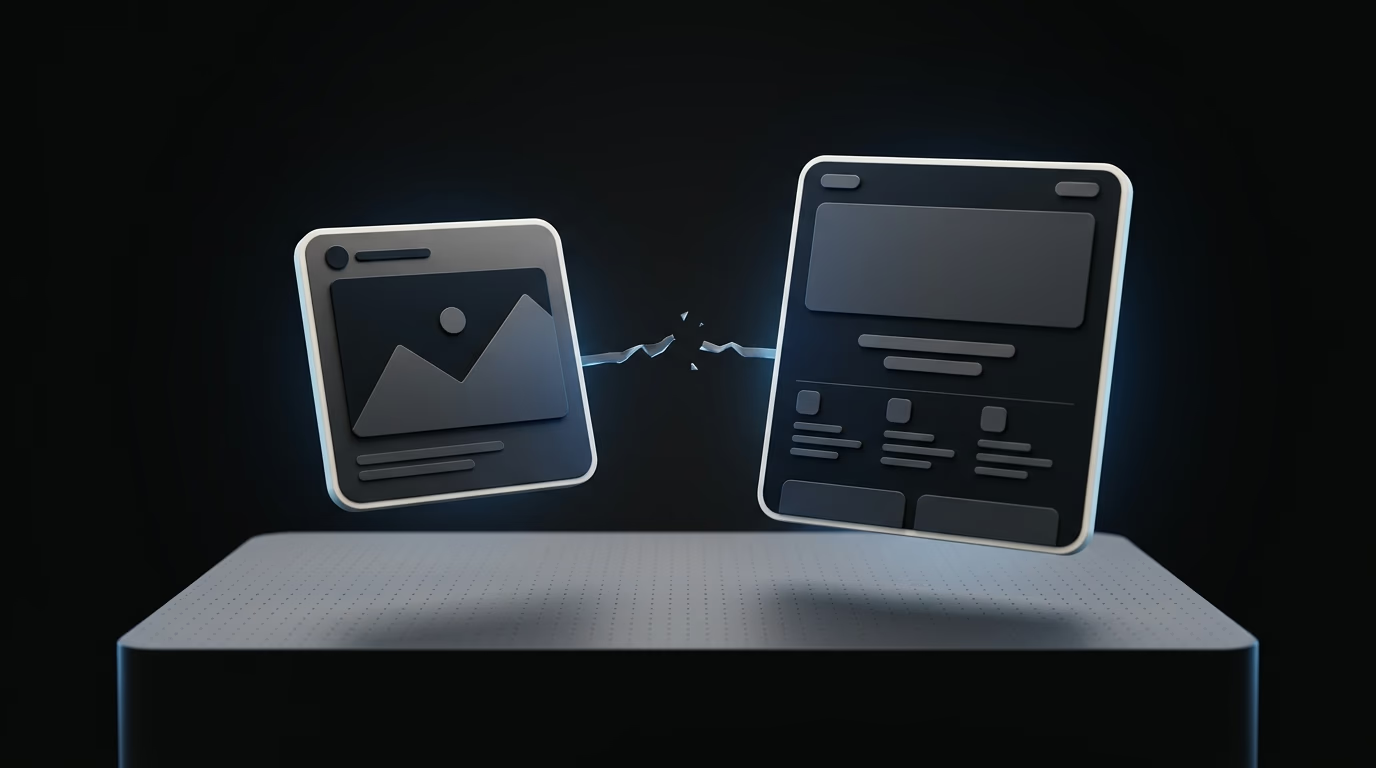
A Facebook ad sets expectations. It frames a problem, positions a solution, and primes the visitor.
Research from Nielsen shows that ads with strong message alignment across the customer journey can improve conversion effectiveness by 20–30% compared to disjointed experiences (Nielsen, 2022). That gap is exactly where most landing page analysis fails.
Yet most landing page analysis assumes a neutral visitor.
That person doesn’t exist.
Different users arrive with different mental contexts:
- One saw a benefit-driven hook
- One saw a discount offer
- One saw a problem-focused narrative
All land on the same static page.
The result is predictable: friction, confusion, and lower conversions.
The Hidden Performance Leaks Across the Ad-to-Page Journey
Looking at pages in isolation hides systemic issues. These are not design flaws—they are structural leaks.
1. Message discontinuity
The ad promises one thing. The page delivers another.
Even small mismatches create friction that compounds across traffic volume.
2. Under-segmented experiences
Multiple creatives drive traffic to a single page. Different intents are compressed into one experience.
No segment is fully satisfied.
3. Limited iteration velocity
Teams test dozens of ads but only one or two landing pages.
Creative evolves. The page does not.
4. No feedback loop
Landing page insights rarely influence new creatives.
This same breakdown appears in Automated Facebook Ads Learning Loops with Instrumnt and Claude Code.
Without feedback, systems stall.
A New Model: Treat Landing Pages as Extensions of Creative Testing
The solution is not better audits. It’s a different model.
Landing pages should be treated as extensions of creative testing.
This changes how you operate:
- You stop optimizing a single page
- You generate variants tied to specific creatives
- You measure performance at the combination level
In this model, a landing page is not a destination—it’s part of the experiment.
This aligns with how high-performing teams approach creative throughput, as explored in Why Your Creative Testing Is Failing (And How to Automate the Solution).
Uploader Workflow: Integrating Landing Page Screenshots into Your Testing Pipeline
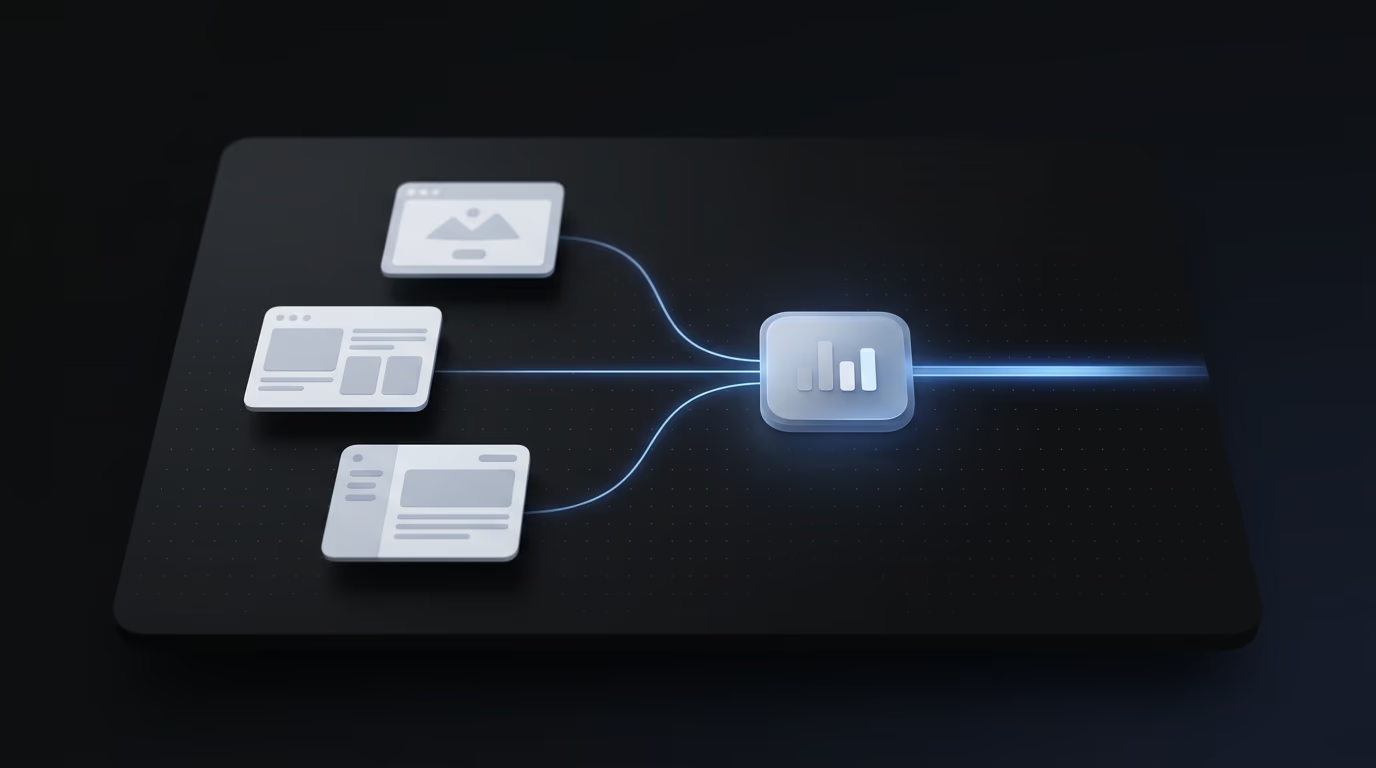
Execution is where most teams break down.
Step 1: Capture landing page states
Treat landing pages as modular or visual assets.
Screenshots, variants, or component-based builds become inputs into your system.
Step 2: Pair creatives with page variants
Each ad should map to 1–3 landing page variants.
You are no longer testing ads—you are testing journeys.
Step 3: Scale combinations with a Facebook ads uploader
Manual workflows collapse under complexity.
A Facebook ads uploader allows you to:
- Launch combinations in bulk
- Maintain structured naming conventions
- Track performance at scale
Tools like Instrumnt make this operationally feasible. Without this layer, testing volume becomes a bottleneck.
Platforms like Smartly.io and Revealbot focus on automation and rules, but they typically stop short of deeply integrating landing page variation into the testing system.
Step 4: Track combinations, not pages
The key metric shifts:
Instead of asking "Is this page good?"
You ask "Which ad + page combination performs best?"
That shift changes how decisions are made.
Operational Playbook: Diagnosing and Fixing Underperforming Flows
To make this actionable, here is a concrete workflow you can apply immediately.
Step 1: Segment by creative intent
Group your Facebook ads by message type:
- Pain-point driven
- Benefit-driven
- Offer-driven
Do not mix them in analysis.
Step 2: Map current landing page alignment
For each segment, evaluate:
- Does the headline match the ad promise?
- Does the opening section reinforce the same narrative?
- Is the CTA consistent with the expectation set?
You will quickly identify mismatches.
Step 3: Create 2–3 aligned variants per segment
Use AI tools like Claude Code to generate:
- Headline variations aligned with each ad angle
- Section ordering based on intent
- CTA framing specific to the creative
This turns static pages into dynamic test assets.
Step 4: Launch combinations using a Facebook ads uploader
Use Instrumnt or a similar system to:
- Pair each ad with multiple page variants
- Launch in structured batches
- Track naming conventions for analysis
Without bulk infrastructure, this step becomes too slow to sustain.
Step 5: Analyze at the combination level
Review results based on:
- Ad + page pair performance
- Drop-off differences between combinations
- Consistent winners across segments
Patterns emerge quickly when analyzed correctly.
Step 6: Feed insights back into creative production
If a page variant consistently wins for a certain angle:
- Double down on that creative direction
- Generate more ads in that category
- Expand page variations further
This closes the loop.
Automating Page Variations for Continuous Improvement
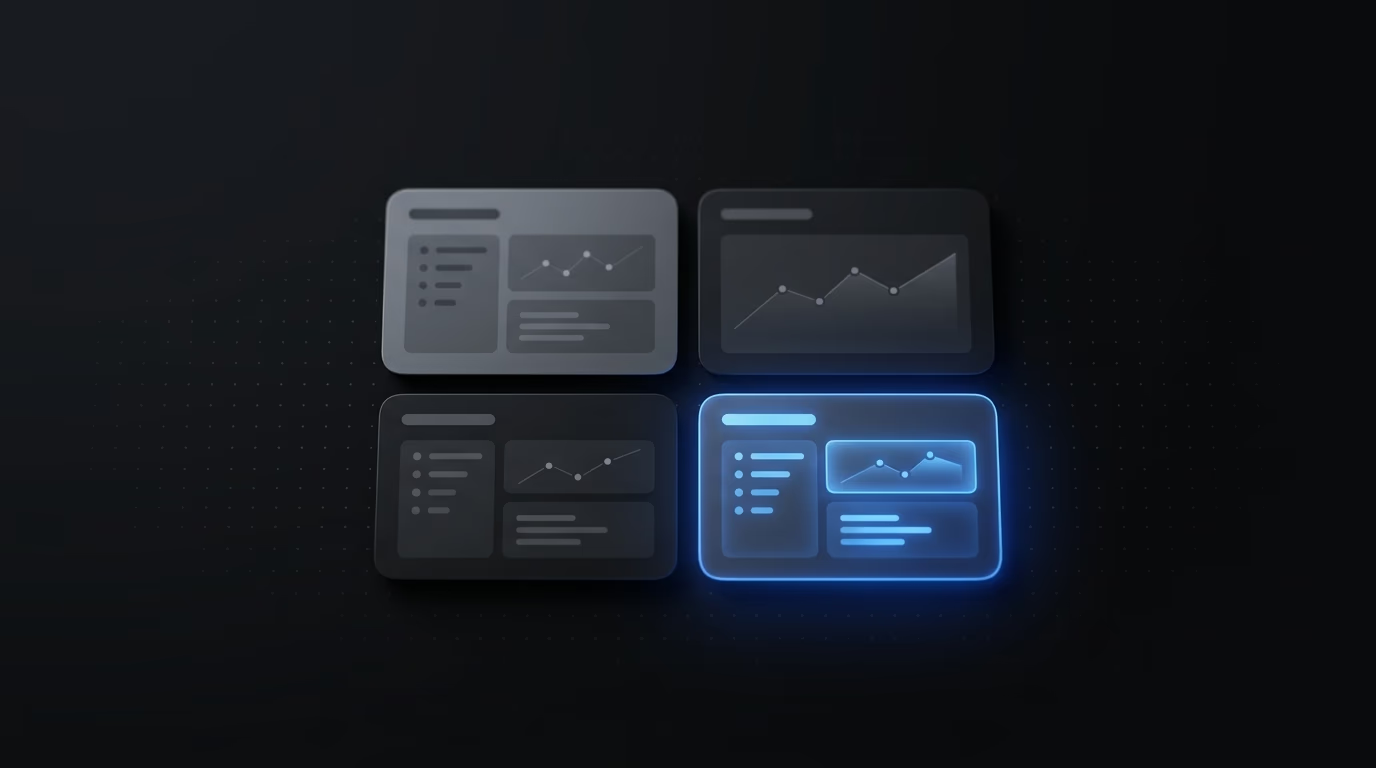
Automation is what makes this sustainable.
Claude Code and AI systems can:
- Generate aligned landing page variants instantly
- Adapt messaging to match creative angles
- Produce dozens of testable combinations
Meanwhile, tools like Instrumnt handle execution and scaling.
This is where most teams fall behind.
They adopt AI for ads, but not for landing pages.
The result is a mismatch between creative velocity and page iteration.
Automation eliminates that gap.
Scaling Insights Across Multiple Campaigns with Instrumnt
Once structured, the system produces compounding insights.
You begin to see patterns:
- Certain page structures outperform for specific creative types
- Messaging sequences repeat across winning combinations
- Some mismatches consistently fail
Instrumnt enables this by standardizing how tests are launched and tracked.
Compared to Smartly.io and Revealbot, which emphasize automation layers, the advantage here comes from structured experimentation across the full journey.
This turns Facebook ads optimization into a repeatable system rather than a series of isolated tests.
What Actually Changes When You Fix This
When landing pages are integrated into the creative testing pipeline, three things shift:
- Conversion rates stabilize across campaigns
- CPA becomes more predictable
- Scaling becomes a function of output, not guesswork
Instead of chasing isolated improvements, you build a system that improves continuously.
The real diagnosis
Landing page analysis fails in Facebook ads because it isolates the wrong variable.
The issue is not the page itself.
It’s the system connecting ads to pages—and the lack of iteration within that system.
Fix the system, and performance follows.
Common questions about facebook ads landing page analysis
Why doesn’t traditional landing page analysis improve Facebook ads performance?
Because it ignores the influence of ad creative. Landing pages are evaluated as static assets, while Facebook ads introduce dynamic intent. Without connecting the two, analysis misses the real cause of performance issues.
How do you connect ad creative testing with landing page optimization?
By pairing each creative with specific landing page variants and measuring results at the combination level. This requires structured workflows, often supported by a Facebook ads uploader and tools like Instrumnt.
What is the fastest way to test multiple landing page variations for Facebook ads?
The fastest approach combines AI and automation. Use Claude Code to generate variations, then deploy them in bulk using Instrumnt or similar systems. This allows you to test dozens of combinations without slowing down execution.
How many landing page variants should you run per ad?
Start with 2–3 variants per ad. As your workflow improves, expand this number. The goal is not precision—it’s volume and pattern recognition.
Do tools like Smartly.io or Revealbot solve this problem?
They help with automation and rules, but they don’t fully solve the structural issue. The real leverage comes from integrating landing page variation into the same testing system as creatives.
For more context, see Meta Ads Guide, Meta Blueprint, and Meta for Business Help Center.
For more context, see Meta Ads Guide.
For more context, see Meta Blueprint.
For more context, see Meta for Business Help Center.